What is a tesseract? The four-dimensional cube, explained and drawn by hand
A tesseract is to a cube what a cube is to a square. Why it looks like a cube inside a cube, how many vertices it has, how to draw it on paper and what it has to do with Interstellar.

Jonás Javier Encarnación5 min read
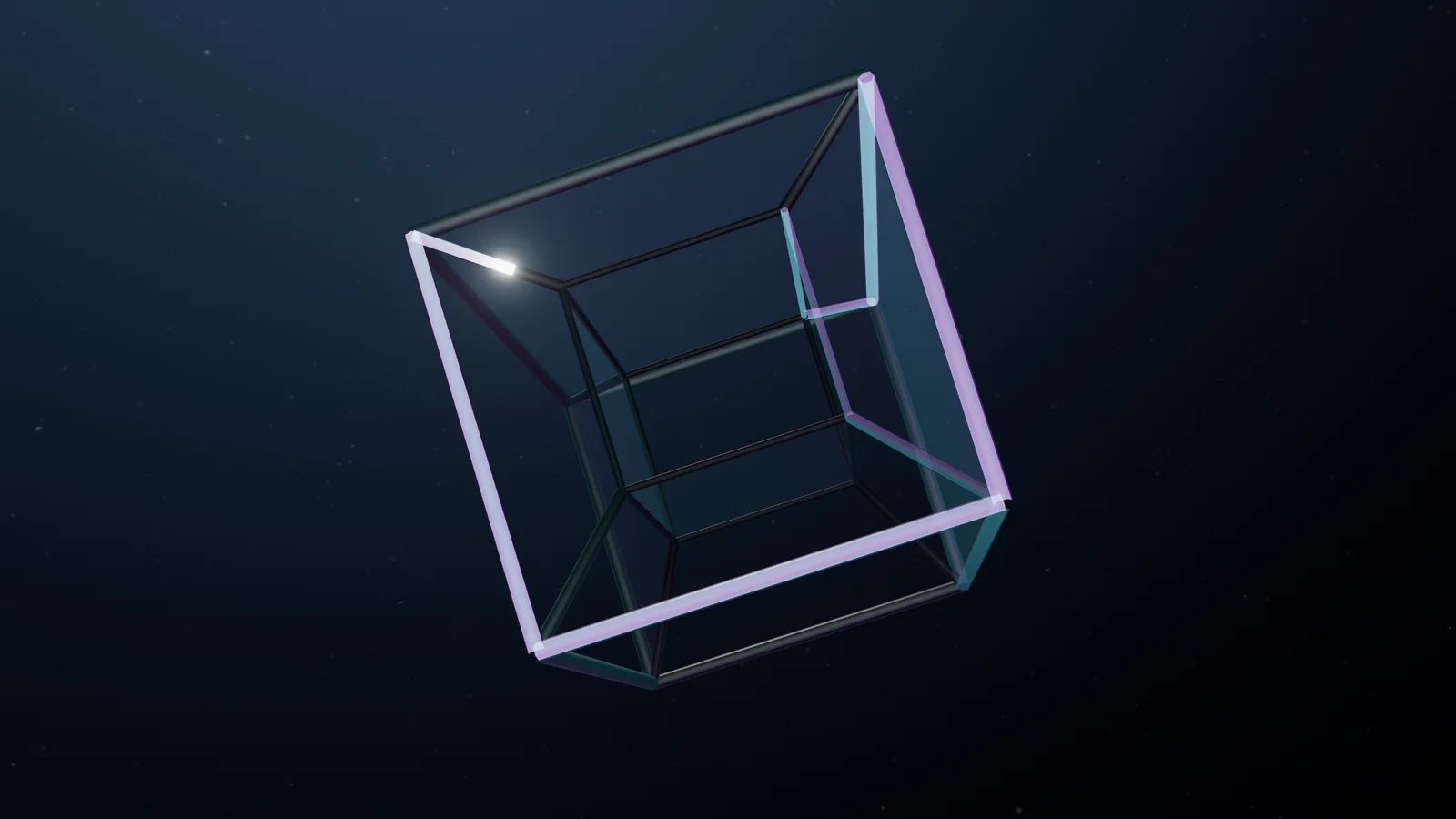
There's a tesseract spinning in this site's Observatory, and the question I get most isn't how it's coded but something earlier: what is a tesseract? This post explains it without formulas, ends with a drawing you can make on paper and, at the end, clears up what it has to do with the one in Interstellar.
The ladder of dimensions
The easiest way to reach a tesseract is to climb one step at a time.
- A point has no dimensions.
- Drag the point in a straight line and you get a segment: one dimension.
- Drag the segment sideways, at a right angle, and you get a square: two dimensions.
- Drag the square upward, at a right angle to both sides it already has, and you get a cube: three dimensions.
- Drag the cube in a direction at a right angle to all three of our space and you get a tesseract: four dimensions.
The last step is the one we can't picture, because there's no fourth direction to point at. But you can reason about it exactly like the earlier ones, and that's enough to count it.
How many vertices, edges and faces it has
Every time you drag a shape, its vertices double (the ones at the start and the ones at the end) and each original vertex leaves a trail, which is a new edge.
| Shape | Dimensions | Vertices | Edges | Square faces | Cubes |
|---|---|---|---|---|---|
| Segment | 1 | 2 | 1 | — | — |
| Square | 2 | 4 | 4 | 1 | — |
| Cube | 3 | 8 | 12 | 6 | 1 |
| Tesseract | 4 | 16 | 32 | 24 | 8 |
So a tesseract has 16 vertices, 32 edges, 24 square faces and 8 cubic cells. Four edges meet at every vertex, one per dimension, just as three meet at every corner of a cube.
Why it looks like a cube inside a cube
When you draw a cube on paper, you aren't drawing the cube: you're drawing its two-dimensional shadow. The back face comes out smaller than the front one, even though on the real cube they're the same size. That's perspective.
A tesseract does the same thing one step up. What we see on a screen, or in the Observatory, is its three-dimensional shadow: two cubes, one inside the other, with their eight corners joined. The small cube isn't smaller: it's the one farther away in the fourth direction, like the back face of the drawn cube. The six pieces joining them, which look like truncated pyramids, are also perfect cubes seen in perspective.
That's why, when a tesseract rotates in four dimensions, it seems to turn itself inside out like a sock: the inner cube grows, comes out and becomes the outer one. Nothing is deforming. What changes is which of its cubes is closest to us in the direction we can't see.
Flatland: how you'd see a tesseract passing by
In 1884 Edwin Abbott published Flatland, a novel about beings who live on a plane. If a cube passed through their world, they wouldn't see a cube: they'd see a square appear out of nowhere, stay for a while and vanish, because they only perceive the cube's slice through their plane.
If a tesseract passed through our space, the same would happen to us: we'd see a cube appear out of nowhere, stay and vanish. That analogy, thinking about how a lower-dimensional being would see our world, is the most useful tool for thinking in four.
How to draw a tesseract by hand
You need paper and a ruler. There are two ways; this is the easier one.
- Draw a cube. A square, an identical one shifted diagonally, and join the four corners. That's 8 vertices and 12 edges.
- Draw a second identical cube, shifted in another direction (say, to the right and a bit down). Don't let it overlap the first one completely.
- Join each vertex of the first cube to the matching vertex of the second. That's 8 more lines.
- Count: 12 + 12 + 8 = 32 edges and 16 vertices. If you get those numbers, it's a tesseract.
The second way is the cube inside the cube: draw a large cube, a smaller one inside it, and join its eight corners to the large one's. That's the perspective view I explained above, the same one the Observatory shows. Both drawings are the same object seen from different places.
If you want to see how it's done in code, with the tesseract actually rotating in four dimensions, I walk through it in How I drew a 4D tesseract in Three.js.
Where the name comes from
The word was coined by the British mathematician Charles Howard Hinton in 1888, in his book A New Era of Thought. It comes from Greek: "four rays", for the four edges leaving each vertex. It's also called a hypercube, though that word is more general: a hypercube can have any number of dimensions, and the tesseract is the four-dimensional one.
If you've ever seen Salvador Dalí's Corpus Hypercubus (1954), the cross in the painting is an unfolded tesseract: its eight cubes laid out in our space, just as a flattened cardboard box is the flat pattern of a cube.
And Interstellar's tesseract?
In Interstellar, after falling into Gargantua, Cooper ends up inside a structure the film calls the tesseract: his daughter Murph's bedroom repeated in every direction, each copy at a different moment. There, time becomes a place you can move through, and Cooper reaches Murph by nudging things in the past with gravity.
It isn't a geometric hypercube like the one in this post: it's an image inspired by it, to stand for more dimensions than we can see. Kip Thorne, the physicist who advised the film, explains the idea in his book The Science of Interstellar. It keeps the essential part of the real tesseract: what we see is always the shadow of something with more dimensions.
Watch it rotate
In the Observatory you can orbit the tesseract while it rotates in four dimensions and, in Study mode, point at an edge to see which axis it runs along. Watch for the moment the inner cube comes out and becomes the outer one: that's the rotation in the dimension we can't see.