Gargantua vs. Sagittarius A* and M87*: Interstellar's black hole against the real ones
Gargantua weighs a hundred million suns. Sagittarius A*, our galaxy's, about four million; M87*, six and a half billion. How big each one is, where it is and why the film picked that one.

Jonás Javier Encarnación4 min read
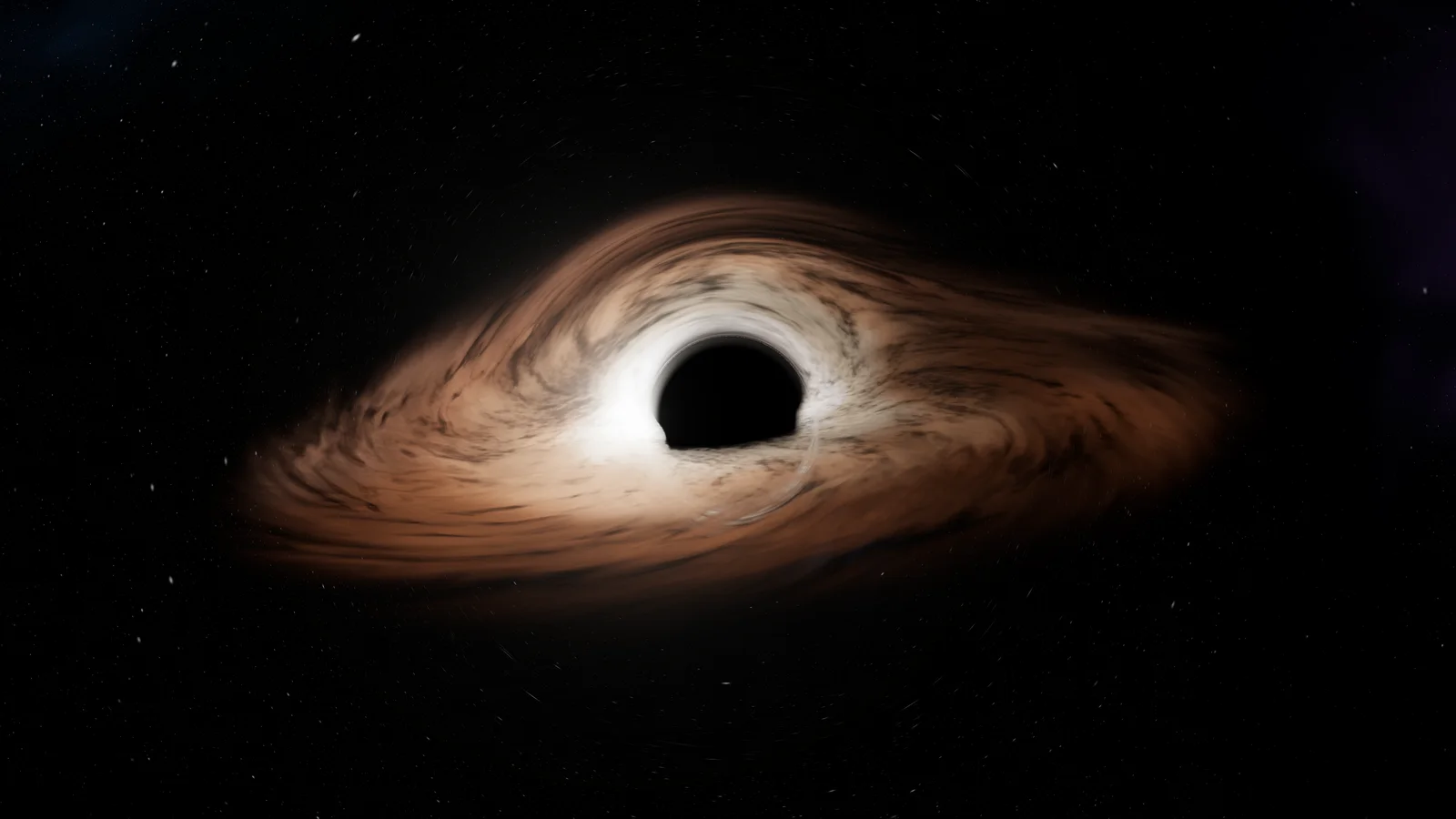
When people finish Interstellar they almost always search for the same thing: does Gargantua exist? Is it bigger than the black hole in our galaxy? I know because those are the questions that bring people to my Gargantua simulator.
The short answer: Gargantua doesn't exist, but it's built from numbers that could. And next to the two black holes humanity has photographed, it sits right in the middle: about twenty times heavier than ours and about sixty times lighter than M87's.
The three of them, in one table
| Gargantua | Sagittarius A* | M87* | |
|---|---|---|---|
| What it is | Fiction (Interstellar, 2014) | The center of the Milky Way | The center of the galaxy M87 |
| Mass | ~100 million suns | ~4.3 million suns | ~6.5 billion suns |
| Horizon radius | ~150 million km (≈ 1 AU) | ~12.7 million km | ~19 billion km (≈ 128 AU) |
| Distance from Earth | The film doesn't say | ~27,000 light-years | ~55 million light-years |
| Photographed | No | Yes, in 2022 | Yes, in 2019 |
One AU (astronomical unit) is the distance between Earth and the Sun. The horizons of Sagittarius A* and M87* are computed as if they didn't spin; their real spin isn't known precisely, and if they spin, the horizon is somewhat smaller.
Is Gargantua bigger than Sagittarius A*?
Yes, by a lot. Sagittarius A* has about 4.3 million times the mass of the Sun; Gargantua, about 100 million. So Gargantua is roughly 23 times heavier.
In size the gap is a bit smaller, because Gargantua spins almost as fast as physics allows, and a black hole spinning at the limit has its horizon at half the radius it would have at rest. Even so, its horizon is about 150 million kilometers in radius, and Sagittarius A*'s about 12.7 million: Gargantua's is about 12 times wider.
To picture it: if you put Gargantua where the Sun is, its horizon would reach roughly Earth's orbit. Sagittarius A* in the same place would fit comfortably inside Mercury's orbit.
And against M87*?
Here Gargantua is the small one. M87* has about 6.5 billion solar masses, about 65 times more than Gargantua. Its horizon, about 128 AU in radius, is more than four times wider than Neptune's orbit: the whole solar system would fit inside.
M87* was the first black hole ever photographed. The Event Horizon Telescope (EHT) released its image on April 10, 2019: a blurry orange ring with a shadow in the middle. Three years later, on May 12, 2022, it released Sagittarius A*. Our neighbor coming second is no accident: even though it's 2,000 times closer, it's so small that seeing it from Earth, in the EHT's own words, is like seeing a donut on the surface of the Moon.
Why did the film pick a hundred million suns?
It isn't a random number. Kip Thorne, the physicist who advised the film, explains in The Science of Interstellar that the mass came from what the story needed on Miller's planet.
Near a black hole, the difference in gravity between one side of a planet and the other —the tidal force— can tear it apart. The counterintuitive part is that this force, at the horizon, is gentler the bigger the black hole is. Around a small one, a few solar masses, a planet would break up long before getting close. Around one of a hundred million suns, a planet can orbit right next to the horizon and stay in one piece.
And sitting right next to the horizon is what it takes for time to run so slowly that one hour on Miller is seven years on Earth. For that, Gargantua also has to spin almost at the maximum: that's what allows a stable orbit so close in. Gargantua's mass and spin are, at heart, the film's plot translated into physics.
Does Gargantua exist?
No. No real black hole is called that, and none we know of has an ocean planet orbiting it. But none of its numbers is forbidden: supermassive black holes of a hundred million suns exist, and astronomers think many of them spin very fast.
What is real is the physics used to draw it. The Double Negative visual effects team wrote, together with Thorne, a ray tracer that follows light around a spinning black hole, and published it in 2015 as a scientific paper. A curious detail from that paper: for the image in the film they slowed the spin to 0.6 of the maximum, far below what the story needs. At high spin the shadow came out flattened on one side, with several images of the disk crowded against that edge and the disk off-center, and Christopher Nolan and Paul Franklin, the visual effects supervisor, felt it would confuse audiences.
Where is Gargantua, and how far is it from Earth?
In the story, in another galaxy. The crew gets there through a wormhole that appears near Saturn, so the actual distance doesn't matter for the trip, and the film never states it. For reference: the nearest large galaxy, Andromeda, is about 2.5 million light-years away.
See it yourself
In my simulator you can orbit Gargantua and switch off the lens, the Doppler effect and the secondary images to see what each one does. If you want to understand why it looks the way it does —the shadow, the disk above and below, the photon ring— I explain it in The physics of Interstellar's black hole. And if you're after a wallpaper, here are the 4K Gargantua wallpapers.