ObservatorySpecimen 6 of 6
Gargantúa Interstellar’s black hole, in 3D
LENS / DISK
InstrumentStandby
An interactive interpretation of a rotating black hole. Switch between four views to explore gravitational lensing, the accretion disk and the Doppler effect.
Build notes
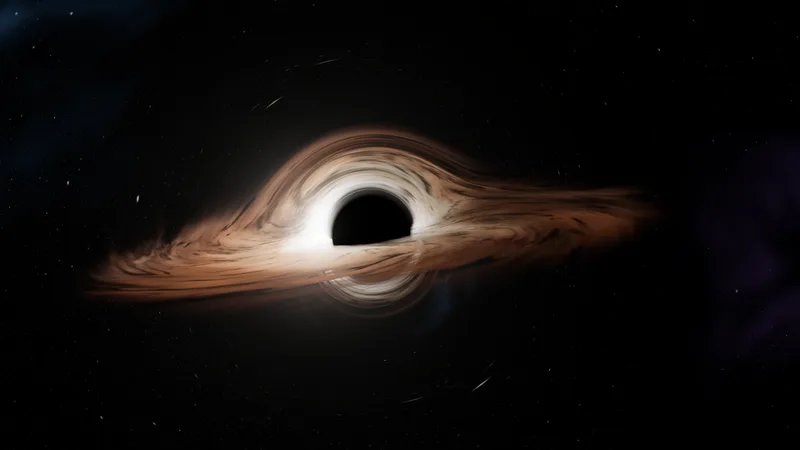
- It is not a mesh: it is a geodesic raymarch on a full-screen quad. Each pixel follows a ray of light that bends around the horizon until it falls in or escapes, with 190 steps per pixel at the normal level and 340 at the deep one.
- The accretion disk is noise rotating at Keplerian speed. Relativistic Doppler beaming, added to gravitational redshift, makes the approaching side shine more than twice as bright as the receding one.
- The image accumulates across frames with two ping-pong render targets and a Halton sequence, so it sharpens while the view holds still. The Doppler, Secondary images and Lens controls switch off real branches of the shader.
- Bloomunavailable
- Dopplerunavailable
- Secondary imagesunavailable
- Lensunavailable
- Dataunavailable