ObservatorySpecimen 1 of 6
Tesseract
Four-dimensional geometry
GLASS / FOURTH DIMENSION
InstrumentStandby
A tesseract, the four-dimensional hypercube inspired by Interstellar: sixteen vertices rotating through the fourth dimension, as glass in real time with WebGL.
Build notes
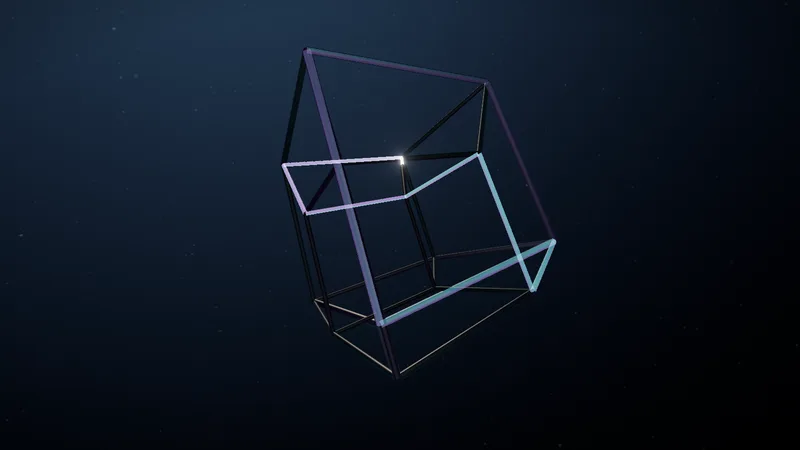
- Sixteen vertices numbered 0 to 15: each of their four bits says which side they sit on in X, Y, Z and W, and two vertices share an edge when they differ in a single bit. That gives 32 edges, 24 faces and 8 cells.
- It rotates in the XW, YW and ZW planes, the ones that mix our space with the fourth dimension, and is projected to 3D with perspective from W: depth in W shares thickness and light between the near cell and the far one.
- Four Three.js meshes share a single GLSL shader: six-sided glass tubes with a Fresnel glow, the light tip and its trail in additive blending, six glass panes and an occluder that only writes depth.
Log
- Intent
- To find out whether a four-dimensional shape could read as an object rather than a diagram.
- Test
- The first version was mathematically correct and impossible to read: thirty-two glass edges the eye couldn't sort into depth.
- Build
- Sixteen vertices rotating across four planes and projected in perspective, traced by a light that completes an Eulerian circuit. Four draw calls and one shared material.
- Result
- Legibility didn't come from exposure but from hierarchy. Each vertex publishes its depth in the fourth dimension, and that value splits light and thickness between the hypercube's two cells: thick and bright up close, thin and dim far away.
- Iterations
- The frame corridor, the compact box and a brighter exposure were all thrown out. What worked was the opposite: dimming the far cell.
- Bloomunavailable
- Materialunavailable
- Dataunavailable
- Logunavailable