How to hire a freelance web developer in the Dominican Republic
What to look for in a portfolio, what a proposal has to say, why you should ask for progress you can open on your phone, and what to ask about the domain, the code and what comes after. What I'd ask for if I were the client.

Jonás Javier Encarnación6 min read
Every so often I hear from someone who's already had a bad experience: they paid for a website or a system, got something half finished, and now they have neither the code nor access to their own domain. It's almost never a talent problem. It's a hiring problem: no written scope, no progress to look at, and no clarity about who owns what.
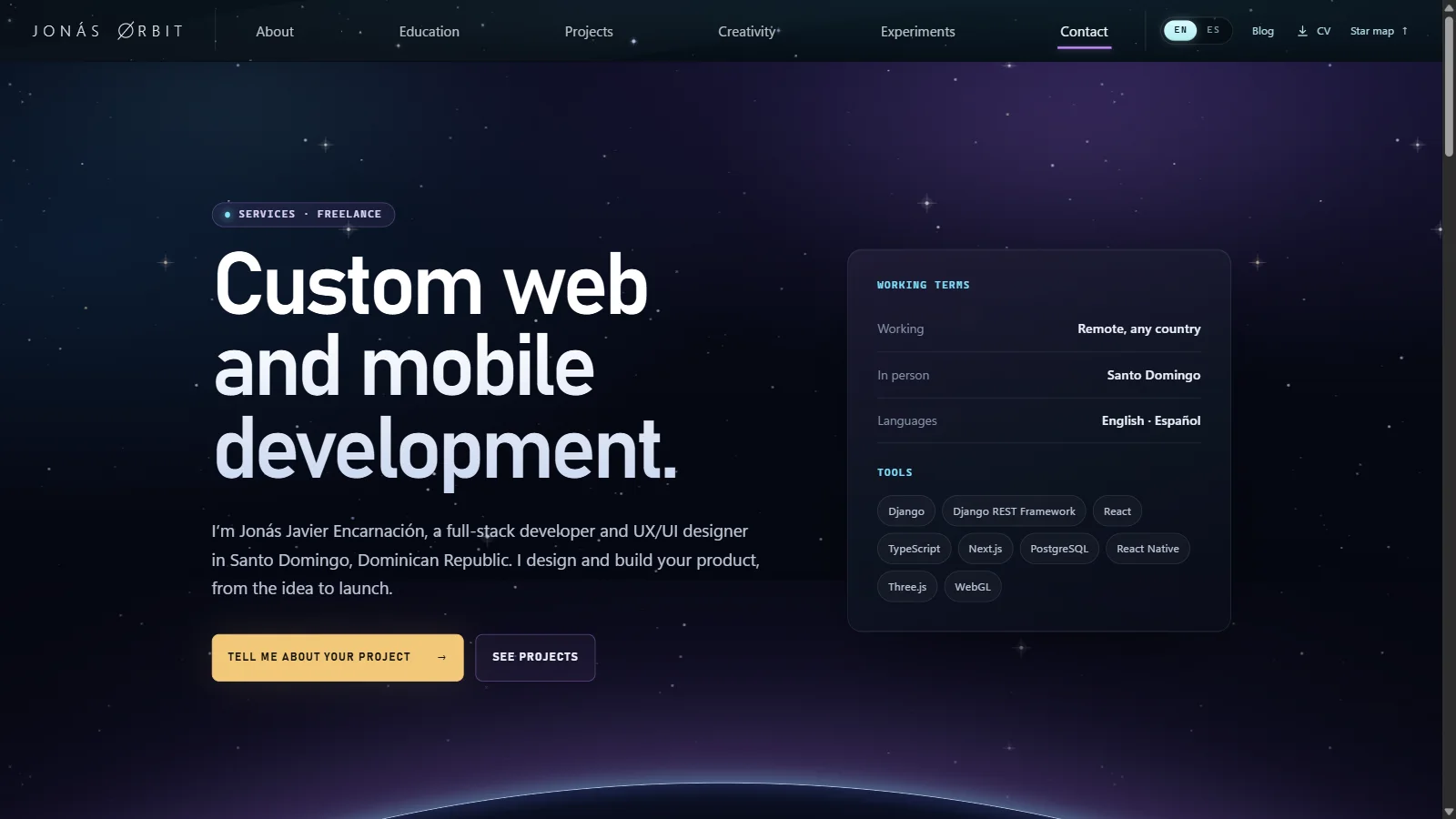
I'm a freelance full-stack developer in Santo Domingo, and I work with clients here and abroad. This guide is what I'd ask for if I were on the other side of the table. It works for hiring me, and it works just as well for hiring anyone else.
Before you search: what problem are you solving?
"I need a website" is the most common starting point and the least useful one. Before you talk to anyone, try to answer three questions:
- Who will use it, and for what? A site that presents your business, a store where people pay, an internal app your team works in every day, and an app on your customers' phones are four different projects.
- What does success look like? More bookings, fewer calls asking the same question, an inventory that finally adds up. If you can say it in one sentence, the developer can design for it.
- What do you already have? A logo, photos, a catalog in Excel, an Instagram account that works. All of that saves time and money.
You don't need to know technology. You need to know what you want to happen once the project is live.
Look at full case studies, not screenshots
A portfolio of pretty screenshots tells you little. What actually informs you is a case told in full: what the problem was, what was decided and why, what it was built with, and what happened after. If a developer can explain their decisions, they'll be able to explain yours.
In my case, projects are published that way. OMSTA is the management system of a real travel agency, with its mobile app, and Delicaté is an online store running in production on its own domain. In each one you can read the scope, the design decisions and the engineering, and open the demo where there is one.
Two questions worth asking about any case: is it in use today? and which part did you build? Both have honest answers and evasive answers, and you can tell them apart.
Ask for a written proposal
"How much does it cost?" is the question everyone asks first, and the honest answer is always the same: it depends on the scope. What you can demand is that the scope be written down before you pay anything. A serious proposal has, at a minimum:
- What will be built, in language you understand, screen by screen or feature by feature.
- What's not included. This section prevents most arguments.
- A timeline in dates or weeks, not "soon".
- Budget and payment terms, with what's delivered at each payment.
- What's needed from you and by when: copy, photos, access, decisions.
I send that proposal after the first conversation and before writing a line of code. If someone gives you a fixed price in their first message, having barely asked you anything, they're guessing.
Progress you can open on your phone
The simplest way to avoid surprises is to see the project while it's being built. Not screenshots: a real link you can open on your computer or your phone, tap through, and show to anyone you like.
In my workflow, every milestone goes up on a link like that. It does two things: you see that the thing exists and is moving, and we both catch what needs changing early, while changing it is cheap.
Ask who owns the domain, the code and the accounts
This is where most people lose out. Before starting, get it in writing:
- The domain is in your name. You hold the account it was registered with, not the developer. If they register it for you, they transfer it or hand you the access when the work is done.
- Hosting and services (email, payment gateway, database) live in your accounts, or in accounts where you have owner access.
- The code is yours once it's paid for, and you receive a copy or access to the repository.
- There's a list of credentials delivered at the end, with everything someone else would need to pick up the work tomorrow if it came to that.
A serious developer isn't bothered by these questions. They're normal.
What happens after launch
A website or an app isn't finished the day it goes live. There will be adjustments, a domain renewal every year, and one day you'll want to add something. Ask:
- Who handles publishing it and the domain?
- What happens if a bug shows up in the first weeks?
- How are small changes billed afterwards?
In my case, I take care of the release and the domain, and I stay around after delivery. What matters is that you know beforehand, not that you find out when something breaks.
Remote or in person, in English or Spanish
Working with someone in the Dominican Republic has an obvious upside if your business is here: same time zone, same language, and meeting in person when it helps. But hiring a freelancer no longer requires them to be in your city. I work remotely with clients in any country, in English or Spanish, and in Santo Domingo we can meet face to face.
What remote work does require is clear communication: an agreed channel, answers within a reasonable time, and decisions in writing. Ask what that communication will look like before you start.
Warning signs
A few things that, if you see them, are worth stopping for:
- Nothing is in writing, or the scope is one sentence.
- They can't show you a project in use, or can't explain what they did on it.
- Everything will be "ready in a week", whatever it is.
- They don't ask you questions about your business.
- The domain or hosting is "easier if I put it in my name".
- They ask for full payment up front.
None of these proves bad faith on its own. Together, they almost always do.
How I work
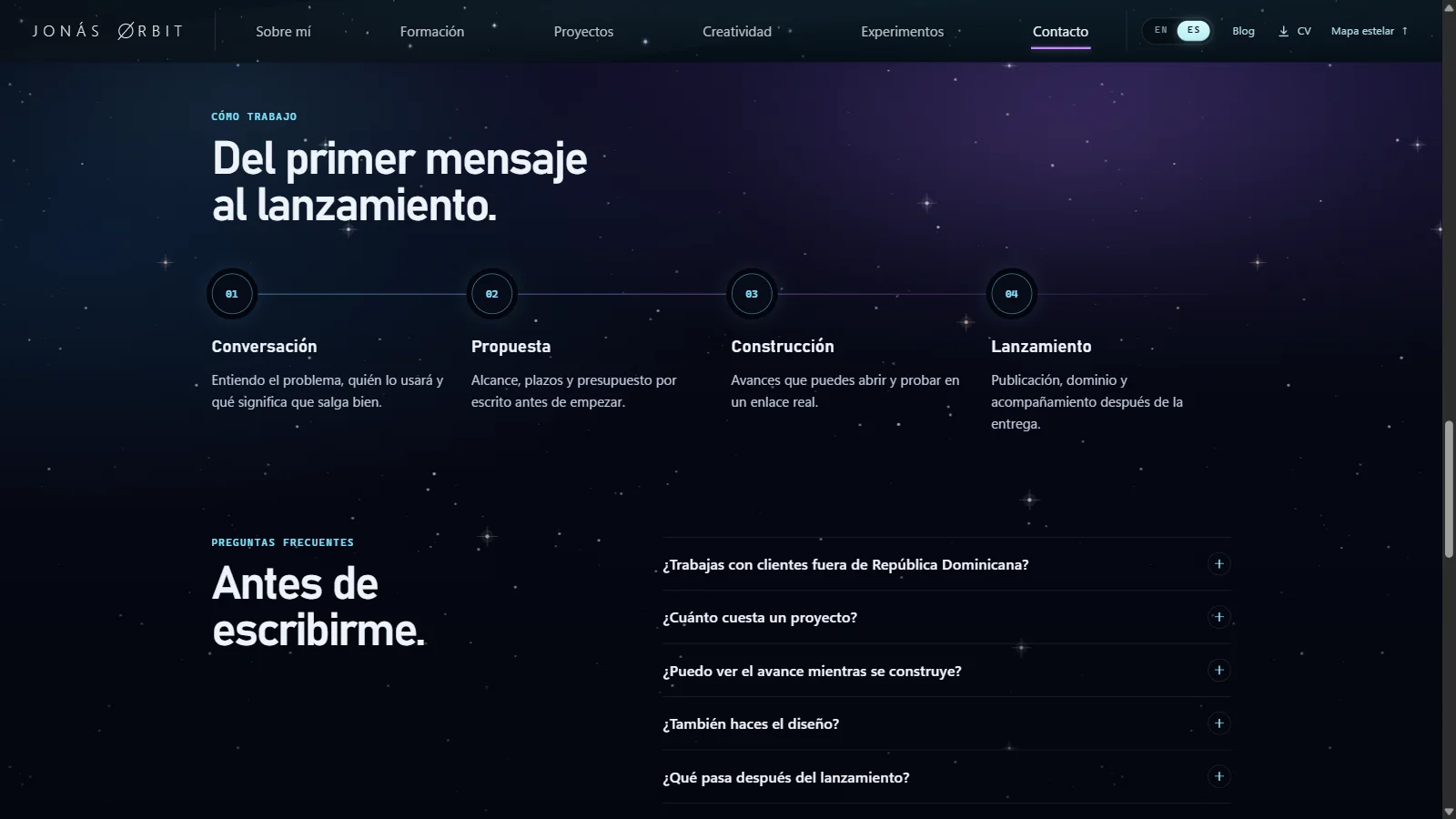
So you're not left with theory, this is what a project with me looks like from start to finish:
- Conversation. I learn the problem, who will use it and what success looks like.
- Proposal. Scope, timeline and budget in writing, before we start.
- Build. I design the interface before coding it, and every milestone goes up on a real link you can open and try.
- Launch. Release, domain and support after delivery.
I build custom web applications with Django and React, online stores and business sites, mobile apps with React Native and, when a project calls for it, 3D experiences like the ones on this site. All with published case studies you can open before you write to me.
Write to me
If you have a project in mind, tell me about it on the services page or straight through Contact. I read every message and reply personally. And if all you wanted was this guide to hire someone else, use it: that's what it's for.